

University Research Agencies
The University research agencies are separate from the academic research activities of the University. These organizations focus primarily on technology development and transfer and are oriented toward making Michigan and U.S. industry more competitive.
Institute of Materials Processing
Academic Research Centers and Institutes
Academic research centers and institutes have a focused, interdisciplinary theme and usually involve faculty from several academic departments. Each center or institute has a director who is appointed by the president of the University. Academic research centers and institutes are intended to foster creative, collaborative, cross-disciplinary research efforts that enhance the research and educational programs of the University. Each of these centers or institutes is located within a college or school for administrative purposes but may include faculty from any college or school within the University.
 Institute
of Materials Processing
Institute
of Materials Processing
Director, J. Y. (Jim) Hwang
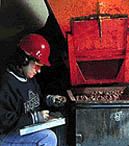
The Institute of Materials Processing (IMP) is an innovative, nonprofit research facility. The institute focuses on the extraction, processing, recycling, and utilization of materials and resources. It conducts sponsored technology development, research, problem solving, training, and technology services for MTU, the state of Michigan, other governmental units, and industry. Materials studied include metallics, ceramics, polymers, composites, minerals, and industrial processing wastes. Expertise includes bench-top experimentation through process development, pilot plant scale-up, and commercialization.
 Keweenaw Research
Center
Keweenaw Research
Center
Director, James C. Rogers
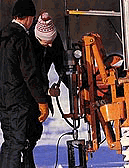
The Keweenaw Research Center (KRC) is a multidisciplinary laboratory wholly supported by external funding. Research and development activities are primarily based on a broad spectrum of ground vehicle performance with particular expertise in cold environments. Typical activities include vehicle design and operation as an integrated system, material properties of tracked and wheeled vehicle components, vehicle-terrain-human interactions, and signatures as related to vehicle identification and characterization. Computer-aided engineering and modeling are used extensively.
The Institute of Snow Research, an auxiliary component of KRC, is engaged in basic and applied research into snow, ice, and cold environment engineering. Fundamental study of ice sintering, dynamic behavior of snow, and the mechanism of ice adhesion are some recent examples. KRC provides opportunities for graduate students and faculty to perform research in several areas
 composite materials thermal modeling computational algorithms composite materials thermal modeling computational algorithms |
finite element methods vehicle dynamics modeling |
Academic Research Centers and Institutes
 Center
for Experimental Computation
Center
for Experimental Computation
Director, James R. Hoel, College of Sciences and Arts
This center houses a multidisciplinary effort dedicated to advancing state-of-the-art computer technologies, software, and applications. Research activities currently center upon developing the uses of parallel computer processing for solution of computing-intensive problems in condensed matter, atomic and molecular physics, linear algebra problems, and general studies in the area of computer science and scientific computation. The CEC facilities are housed in Fisher Hall and consist of an Intel iPSC-II Hypercube computer, twelve Sun servers, several Sun workstations, an alpha server, and several smaller computers.
Center for Manufacturing Research
Acting Director, Klaus J. Weinmann, Department of Mechanical Engineering-Engineering Mechanics
The Center for Manufacturing Research encompasses research in materials processing, automated manufacturing, metrology, and computer modeling of manufacturing processes. Specific research projects have included sheet metal forming, blow molding of polymers, computer simulation of robots, and data-dependent simulation of metal cutting. Research contracts have been with both industry and government agencies. Facilities include a modern sheet metal forming laboratory and an automated manufacturing cell.
 Environmental
Engineering Center
Environmental
Engineering Center
Director, Neil J. Hutzler, College of Engineering
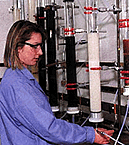
The University Environmental Engineering Center is organized under the College of Engineering and strongly supported by the Department of Civil and Environmental Engineering. The purpose of the center is to facilitate interdisciplinary research and education in environmental science and engineering. The center provides an administrative home for the nondepartmental environmental engineering doctoral program, the Educating Engineers for the Environment Project, the Regional Groundwater Education in Michigan Center, and the National Research Center for Clean Industrial and Treatment Technologies. Participating faculty hold appointments in the Departments of Civil and Environmental Engineering, Chemistry, Chemical Engineering, Geological Engineering and Sciences, Biological Sciences, and Metallurgical and Materials Engineering, and the School of Forestry and Wood Products. The group also includes a number of graduate research assistants, supported by grant and contract research, as well as secretarial and technical staff. The principal laboratory research and office facilities are located in the Chemical Sciences and Engineering Building on the Michigan Tech campus.
Fluids Research Oriented Group (FROG)
Codirectors, Robert W. Kolkka, Department of Mathematical Sciences
Faith Morrison, Department of Chemical Engineering
This research center focuses on interdisciplinary research in the area of fluid mechanics and has associated faculty from mathematics, physics, mechanical engineering-engineering mechanics, and chemical engineering departments. Research areas covered are turbulence, non Newtonian flows, and heat and mass transfer. This group runs an active seminar series and annually publishes several technical reports. The group has important links with other academics and industry, both regionally and nationally.
 Ford Forestry Center
Director, Warren E. Frayer, School of Forestry and Wood Products
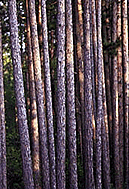
The (Ford) research forest consists of more than 4,000 acres of forest land near Alberta, Michigan, forty miles south of campus. A portion of the land was donated to the University by the Ford Motor Company in 1954. Today, the Ford Forestry Center provides an outdoor laboratory for forestry education and research. The Alberta facility also serves as a center for scientific and professional conferences.
Institute for Engineered Materials
Director, Donald E. Mikkola, Department of Metallurgical Engineering
The Institute for Engineered Materials has been established to encourage and facilitate creative, collaborative, interdisciplinary research dealing with the development of materials having specific properties.
Developments in the study of engineered materials include: the experimental characterization of materials and materials defects on an atomic scale; the development of new processing techniques to practice component architecture, to form a wide array of composite forms, and to fabricate previously unworkable materials; the availability of sophisticated dynamic control systems for manufacturing and materials production; and the evolution of high-speed computation to permit first principles calculation to guide research from the atomic scale through macroscopic component design, as well as to simulate component response under various service conditions.
 Institute
of Wood Research
Institute
of Wood Research
Director, Gary D. McGinnis, School of Forestry and Wood Products
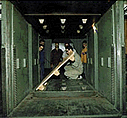
The mission of the Institute of Wood Research (IWR) is to support the environmentally responsible development, use, reuse, and disposal of wood products through three main foci: teaching, research, and service. The institute has both undergraduate and graduate programs in wood science and technology, which provide trained personnel to the forest products and related industries and to federal and state agencies. IWR works closely with industry through research in composite wood products, adhesives, wood preservatives, biotechnology, and environmentally related studies.
Lake States Forest Resource and
Environmental Management Cooperative (LS-FOREM)
Director, David Karnosky, School of Forestry and Wood Products
Initiating and promoting forestry research that will benefit the northern regions is the primary function of the cooperative. Formed in June 1983, the cooperative serves the needs of the forestry and forest products industries as well as state and federal governments by applying Michigan Tech research to the specific problems of forest production in cold-climate regions. Current research topics that the cooperative is developing include forest site selection, larch improvement, managing forested wetlands, northern hardwood management, and white birch regeneration. The cooperative is also supporting research in improving forest productivity and ecosystem management.
Lake Superior Ecosystem Research Center
Director, W. Charles Kerfoot, Department of Biological Sciences
Associate Director, Kurt S. Pregitzer, School of Forestry
and Wood Products
The Lake Superior Ecosystem Research Center (LaSER) is an interdisciplinary center comprised of faculty from the Departments of Biological Sciences, Geological Engineering and Sciences, Civil and Environmental Engineering, and the School of Forestry and Wood Products. The center's three main goals are to
promote and strengthen ecological research and graduate programs at
MTU through developing and applying technological advances to ecological
problems
advocate an ecosystem perspective for studying aquatic and terrestrial
portions of the Lake Superior watershed
become a resource center for basic information on watershed and lake
properties
 Mineral
Technology/Biotechnology Research Group
Mineral
Technology/Biotechnology Research Group
Director, Allan Johnson, Department of Mining Engineering
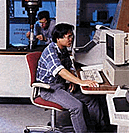
The Mineral Technology/Biotechnology Research Group functions largely to serve the mining and minerals industries through the development and application of new technology. A major emphasis is research on new processes and techniques for solving problems and cutting costs. A special long-term goal has been research leading toward the economic development of significant mineral resources in Michigan and the region.
MTU Regional
Groundwater Education in Michigan (GEM) Center
Director, Neil J. Hutzler, College of Engineering
Coordinator, Kristine Bradof, Environmental Engineering Center
The MTU Regional GEM Center provides objective information, educational programs, and technical expertise on groundwater-related issues to promote informed local and regional decision making that will protect and wisely manage the water resources of Michigan's Upper Peninsula and the upper Great Lakes basin.
The center is a collaborative effort among faculty, staff, and students in the Departments of Biological Sciences, Civil and Environmental Engineering, Geological Engineering and Sciences, the School of Business and Engineering Administration, and the School of Forestry and Wood Products.
 National
Center for Clean
National
Center for Clean
Industrial and Treatment Technologies (CenCITT)
Director, John C. Crittenden, Department of Civil and Environmental Engineering
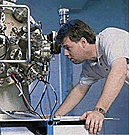
Established in 1992 by the U.S. Environmental Protection Agency, CenCITT is a multi-university, interdepartmental research consortium addressing clean technology needs of interest to industry, government, and the public. Ongoing research projects fall in the areas of
pollution prevention design tools
pollution prevention needs surveys
fluid separation processes
solids processing and reuse
production process reaction pathways
clean process advisory system
MTU is the administrative lead organization. Consortium members are the University of Wisconsin and the University of Minnesota. Units currently funded at MTU include the Departments of Civil and Environmental Engineering, Chemical Engineering, Metallurgical and Materials Engineering, Geological Engineering and Sciences, and Biological Sciences; the Institute for Wood Research; and the School of Business and Economics. Support is provided for four full-time technical staff and a number of graduate and undergraduate research assistants.
 Phytotechnology
Research Center
Phytotechnology
Research Center
Director, Wilbur H. Campbell, Department of Biological Sciences
The Phytotechnology Research Center was formed in 1990 and is an interdisciplinary center with three faculty members from the Departments of Biological Sciences and Chemistry. PRC's central focus is on doctoral student education and collaborative research efforts in the areas of plant biotechnology, plant sciences, and technological applications of plant products. The center is in the process of establishing a graduate student fellowship program for interdisciplinary studies that bridges the traditional graduate programs within the Departments of Biological Sciences and Chemistry. PRC faculty use the latest advances in genetic engineering and molecular microanalysis, as well as many traditional approaches, to study plant physiology and biochemistry.
Transportation Technology Transfer Center
Director, Bernard D. Alkire, Department of Civil and Environmental Engineering
The center was established in 1986 to promote technology transfer to county and municipal transportation officials in the state of Michigan. In 1992 the center expanded its activities to include Native American tribes in the eastern United States. The main functions are educational and include the following: presentation of workshops and seminars that bring new technology in transportation engineering to transportation officials, publication of a newsletter that alerts the transportation community to new technology and educational opportunities, and information services to help county and municipal agencies and tribal governments locate and use new techniques and methods.